QR FINDER
From a simple metal tag to a wider system of practical ways to connect physical objects with useful information.
QR FINDER
Someone has found what you have lost. What happens next?
Keys left in a café. A suitcase misplaced on a journey. A dog that runs off during a walk.
These situations are different, but they share one problem: even if somebody finds what has been lost, they may have no way to contact its owner.
That is the problem QR FINDER was created to address.
From a small metal tag to a wider system
It began with the idea of making a well-designed metal tag — something attractive and durable, but above all useful. From the start, I wanted it to do more than carry a code.
Traditional tags often have a phone number or other details engraved on them. When those details change, the tag may have to be replaced. I wanted to connect the physical object to a digital profile that could be updated instead.
QR FINDER grew from that idea into a system of metal tags, information stickers and a mobile-friendly web platform. As I worked on it, new products, functions and uses began to emerge.

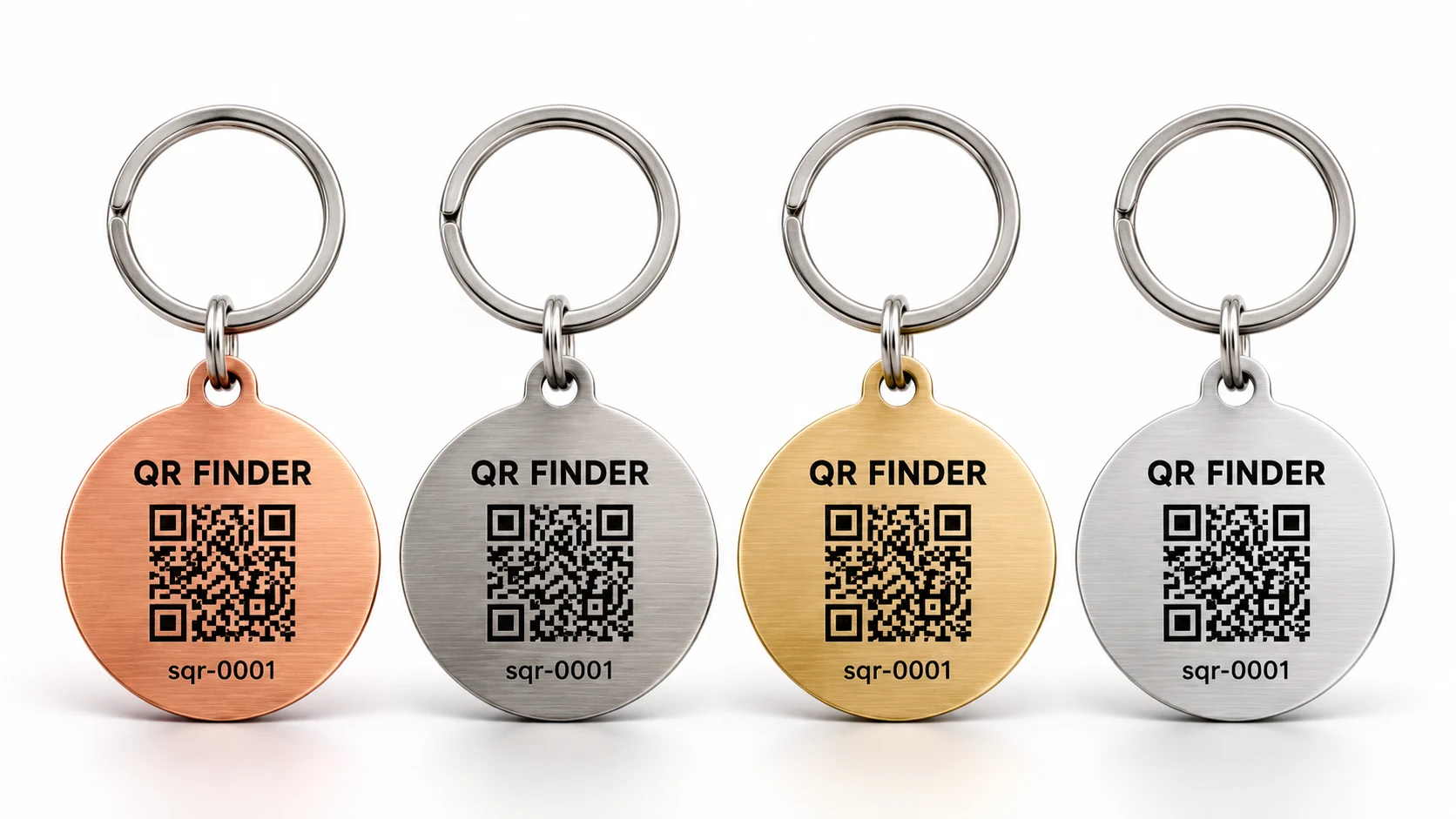 Design preview · four materials
How does it work?
Scanning a code linked to a public profile opens Finder View. The person who finds an item or pet can see the information the owner has shared and use the available contact options, without installing an app or creating an account.
Changed your phone number or need to correct a pet's details? You can update the digital profile without replacing the tag or sticker.
Not everything saved in a profile needs to be visible. The owner chooses which additional details are shared with a finder and which remain private.
When Lost Mode is enabled, a scan can display a clear “Reported lost” notice. If notifications are enabled, the owner may receive the date and time of the scan. A finder can choose to share their location, but it is not tracked automatically.
An example: a pet's profile
Imagine somebody finds your dog. They do not know its habits, whether it is frightened by noise or if it has an allergy or takes medication.
QR FINDER's detailed free pet profile lets owners record useful information about a pet's appearance, behaviour, microchip and veterinary care, as well as important health instructions. Owners choose which additional details they want a finder to see.
That means a tag can tell somebody much more than a phone number while leaving the owner in control of what is shared. It was QR FINDER's first and most detailed free application, but the system is not limited to pets.
Information stickers — new possibilities
Something does not have to be lost for extra information to be useful. That is why I have also been developing QR FINDER information stickers for everyday objects.
A bicycle, electronic equipment, tools, household items, spare parts or something that needs instructions or a record of its history — there are many possible applications. Instead of keeping information in several places, you can associate it with a particular object and access it by scanning the code.
Depending on the profile, available features include photographs, a scan counter, a notepad, a calendar for dates and reminders, and a calculator for quick tasks.
More extensive records, documents and histories may be available through separate paid Books. These premium features should not be confused with the basic free profile.
Public or private? The choice is yours.
Public: the information you choose to share can be viewed by anyone who scans the sticker. This can be useful for instructions, contact details and other information intended to be accessible.
Private: access to the information is protected by a password, for cases where you want a digital record but do not want everyone to be able to read it.
It is the same simple principle — a small sticker linked to useful digital information — adapted to different needs.
Large-format stickers — for cars and beyond
I have also developed larger sticker designs for cars and other applications where a code needs to stand out and be easy to notice.
The larger format is intended to make scanning possible from further away, where lighting, distance and other conditions allow. It could provide quick access to a digital contact card, contact details or other chosen information without anyone having to type in a website address.
A car is only one example. The same approach could be useful wherever visibility matters.
A project that keeps growing
QR FINDER has not developed according to one fixed plan. Many ideas have emerged while designing new products and exploring how people might use them.
I have more ideas I would like to develop, but I would rather share new features when they are ready than make promises too early. I will post updates as the project moves forward.
Why I created QR FINDER
I cannot promise that every lost pet or belonging will be found. A QR FINDER tag does not track an object's location and is not a GPS tracker.
But I wanted to give somebody who finds an important item a simple way to help — to let its owner know that it has been found.
Over time, I realised that the same idea could be useful in many other situations, wherever a physical object could benefit from access to relevant information. That is the direction in which I want to keep developing QR FINDER.
QR FINDER is in the final stages of preparation. Its official website and online shop are not yet open to the public. I will announce the launch date once it is confirmed. The metal tag images shown here are design previews.
QR FINDER enquiries